Trust Architecture for Distribution-First AI Adoption
Continuity Ventures helps insurance and financial-services organizations build AI strategies around the place where the most valuable information begins: the trusted conversation between client and advisor.
AI adoption in regulated advisory markets is not blocked primarily by model capability. It is blocked by trust. The challenge is whether AI-enabled workflows can be governed, reviewed, and responsibly acted upon.
Strategy defines where AI belongs.
Architecture governs how it works.
Proof shows it in practice.
Distribution-First AI Strategy
Where should AI enter regulated advisory workflows, and how can the organization preserve trust when it does? CV helps carriers, advisors, and distribution organizations answer that question with rigor.
- AI workflow readiness assessment
- Distribution-first strategy design
- The Trust Gap white paper
- Executive briefings
Trust Architecture
How should consent, de-identification, human review, provenance, retention, and auditability be built into the workflow? Trust Architecture answers that with a practical, implementable framework.
- Trust Architecture Framework
- DAPT schema
- Clarify/Verify protocol
- Discovery Agreement
OMQ
What does Trust Architecture look like when it runs? OMQ demonstrates how advisor-client conversations become structured Points of Discovery, reviewed through Clarify/Verify, and connected to responsible next actions.
- Advisor-led discovery sessions
- Clarify/Verify in practice
- Points of Discovery
- Section 10 case study
Why Distribution
Comes First
In insurance and financial services, the highest-value information rarely begins inside the enterprise. It begins in distribution — when a client explains a need, an advisor asks a better question, or a planning concern becomes visible for the first time.
That information later powers underwriting, service, suitability, planning, supervision, and enterprise workflows. But if it is captured poorly, structured inconsistently, or stripped of trust before it reaches the enterprise, downstream AI cannot fix the problem.
A distribution-first AI strategy starts where the information starts.
The Trust Gap
The Trust Gap argues that AI adoption in regulated industries is not blocked primarily by model capability. It is blocked by trust.
The challenge is not whether AI can produce useful outputs. The challenge is whether those outputs can be trusted inside governed workflows involving sensitive information, human review, recordkeeping, supervision, and regulated action.
The paper introduces Trust Architecture, DAPT, Clarify/Verify, Trust Boundaries, and Discovery Agreement as practical concepts for moving from trusted human inquiry to AI-enabled workflows that can be responsibly relied upon.
Trust Architecture
The operating framework for financial advisors, carriers, and distribution teams navigating AI adoption in regulated environments. Five components. One system.
Trust Architecture gives organizations a way to govern the lifecycle of material advisory facts — what was discovered, what action may follow, who participated in the Discovery, and when the information was established or updated.
Explore the Framework →
Trust Architecture Framework
A framework for designing AI-enabled advisory workflows that preserve accountability, provenance, privacy, human oversight, and auditability.
Trust Boundaries
The points where information changes state, purpose, system, or control environment — such as Source State, AI Processing State, and Human Working State.
DAPT
Discovery, Action, People, and Timestamp — a compact schema for governing the lifecycle of material advisory facts.
Clarify/Verify
A human review process that allows AI-generated discoveries to be challenged, corrected, updated, and verified before reliance.
Discovery Agreement
A living record of what has been learned, who participated in the Discovery, what action may follow, and when facts were established or updated.
We help regulated organizations design AI workflows that preserve trust as information moves from conversation to action.
Advisory engagements for carriers, BGAs, RIAs, broker-dealers, compliance leaders, and strategic partners navigating AI adoption in insurance and financial services.
Explore Advisory
- AI Workflow Readiness — assessing where AI can safely enter advisor, distribution, underwriting, and compliance workflows
- Trust Architecture Design — mapping consent, de-identification, human review, auditability, and use-case boundaries
- Distribution Strategy — helping carriers and distributors think upstream, where client information is first discovered
- OMQ Demonstrations — using OMQ as a live proof environment for Trust Architecture in practice
- Executive Briefings & Workshops — for leaders, compliance teams, and distribution organizations
Thinking from the field.
AI Adoption Is Blocked by Trust, Not Capability
Models are improving quickly. Regulated adoption depends on whether the workflow can be governed, reviewed, and responsibly relied upon.
Read →
The Unit That Matters Is the Fact
In advisory workflows, the most important unit is often not the document, record, or model. It is the material fact discovered through conversation.
Read →
Why Carriers Should Start at the Distribution Edge
The information powering underwriting, service, suitability, planning, and future enterprise workflows is first discovered in distribution.
Read →
Ready for a serious conversation?
Continuity Ventures works with carriers, advisors, compliance leaders, distribution organizations, and strategic partners focused on regulated AI adoption.
The Trust Gap
Bridging Human Inquiry and AI Workflows in Regulated Industries
The argument in brief.
Artificial Intelligence is advancing rapidly. Yet adoption in insurance and financial services continues to move more slowly than the technology itself.
The primary obstacle is not capability. It is trust.
The Trust Gap is the distance between what AI may be capable of doing and what regulated organizations can responsibly trust it to do. Trust Architecture is the missing operational layer.
Trust is not the result of AI adoption. Trust is the condition that makes AI adoption possible.
The challenge is not whether AI can produce useful outputs in financial services and insurance. The challenge is whether those outputs can be trusted inside governed workflows — by clients, by compliance, and by the practitioners responsible for them.
The Trust Gap documents where that trust breaks down and introduces Trust Architecture as the operating framework for closing it.
Ten sections. One argument.
| 01 | The Trust Gap | Defines the Trust Gap as the distance between AI capability and what regulated organizations can responsibly trust it to do — rooted in the fact that the highest-value information in financial services originates in trusted human conversation. |
| 02 | The Next Migration | Examines how AI adoption parallels the cloud migration, and why it presents a harder challenge: cloud was about where information was stored; AI is about how information is interpreted, transformed, and used to influence decisions. |
| 03 | What Regulators Are Actually Saying | Reviews NIST, FINRA, NAIC, NYDFS, and related guidance. The consistent message: regulators require organizations to prove that workflows remain trustworthy when AI participates. |
| 04 | The Missing Layer | Identifies the operational layer that existing frameworks do not address: governing how individual advisory facts move from trusted human inquiry through AI processing to regulated action. |
| 05 | Trust Architecture Framework | Introduces Trust Architecture as the missing operational layer — a practical framework for preserving trust as information crosses boundaries between human relationships, AI systems, and institutional workflows. |
| 06 | DAPT: Governing the Lifecycle of Facts | Introduces the DAPT schema — Discovery, Action, People, Timestamp — as a durable structure for material advisory facts, making each fact governable from discovery through verification and institutional reliance. |
| 07 | Clarify/Verify: Governing the Lifecycle of Trust | Describes the human review process that interrupts false AI confidence, allowing AI-generated discoveries to be challenged, corrected, and verified before reliance in regulated action. |
| 08 | Trust Boundaries | Maps where information changes state — the De-identification Boundary, AI Processing State, and Restoration Boundary — and what each requires to remain auditable and controlled. |
| 09 | Trust in Practice: From Fact-Finding to Action | Walks through the complete workflow using the Kowalski example: from consented conversation to Points of Discovery to Clarify/Verify to verified Discovery to quote readiness. |
| 10 | Recommendations | Actionable steps for regulated organizations navigating AI adoption, with particular attention to distribution-first strategy. Includes companion video walkthrough of the Kowalski case study. |
The Kowalski Example
Section 9 traces a single client relationship across six critical inflection points. Each exhibit documents a moment where the trust architecture either held or failed.
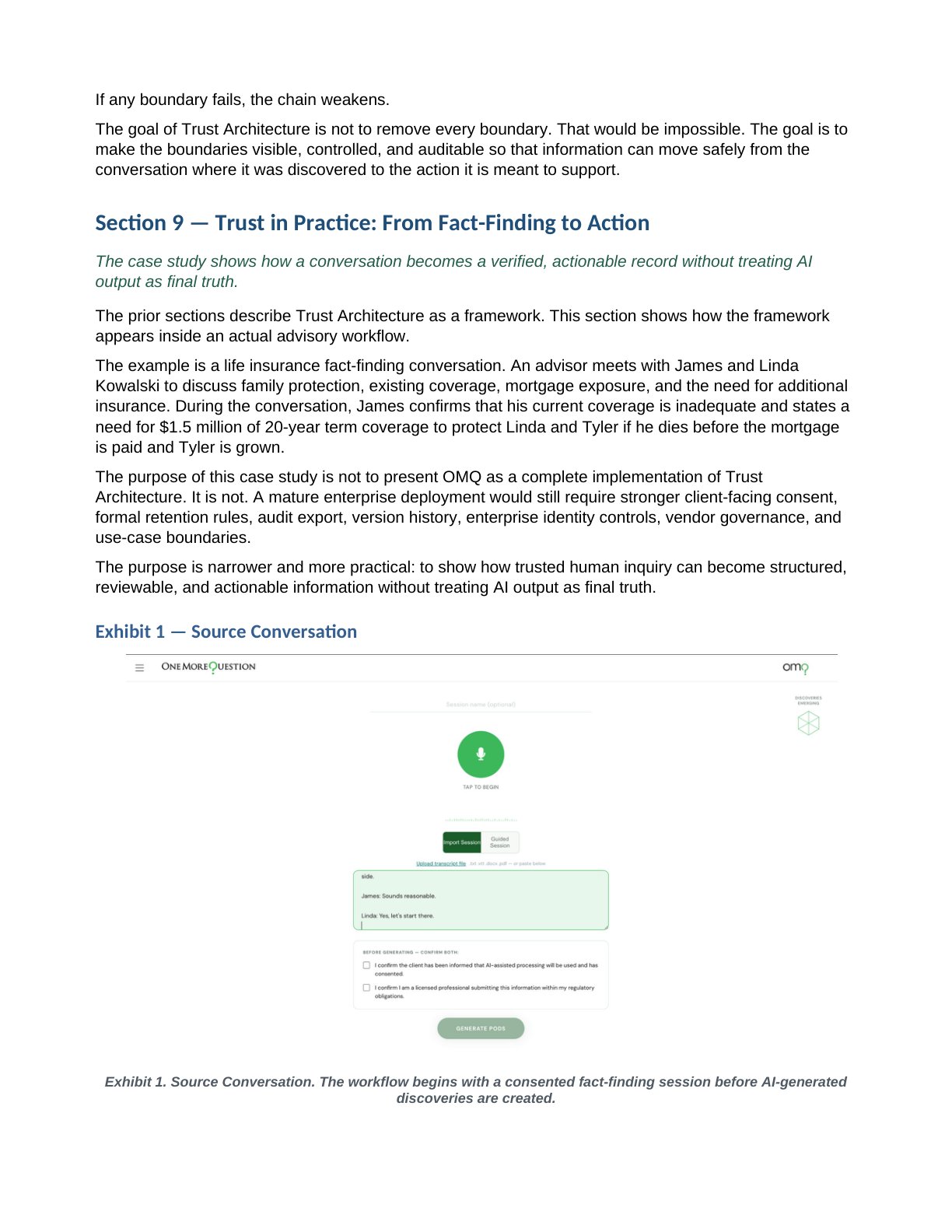
Source Conversation
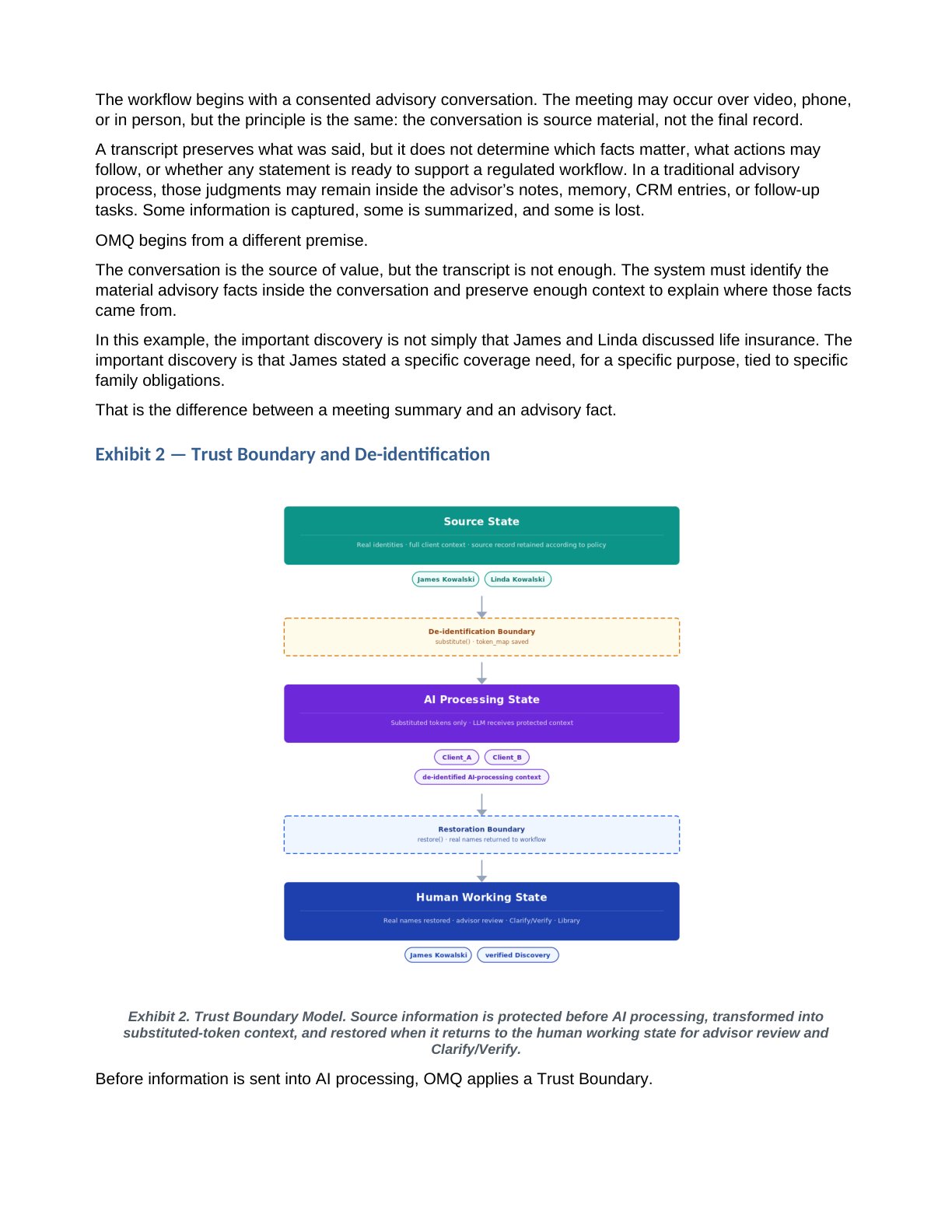
Trust Boundary and De-identification
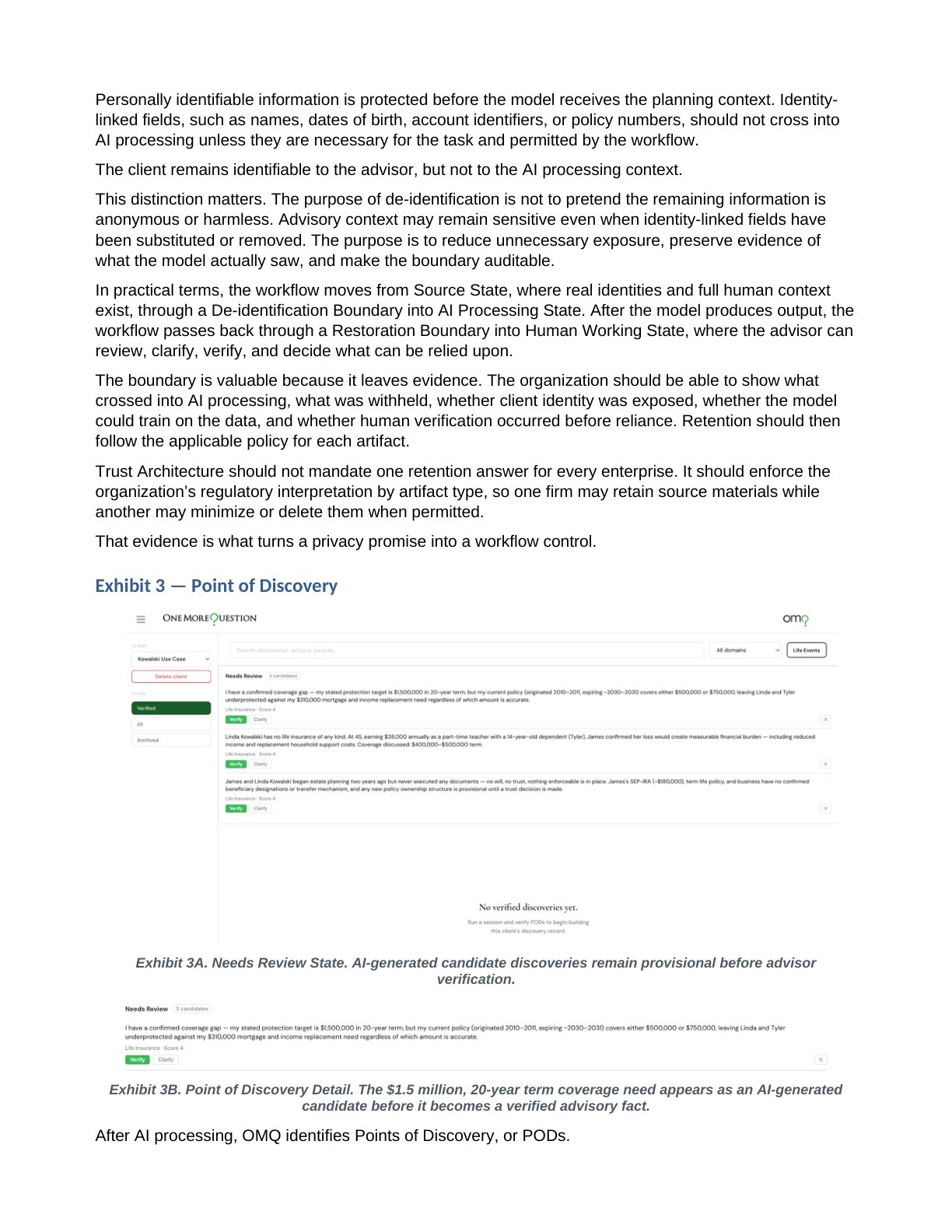
Point of Discovery
Human Review and Clarify/Verify
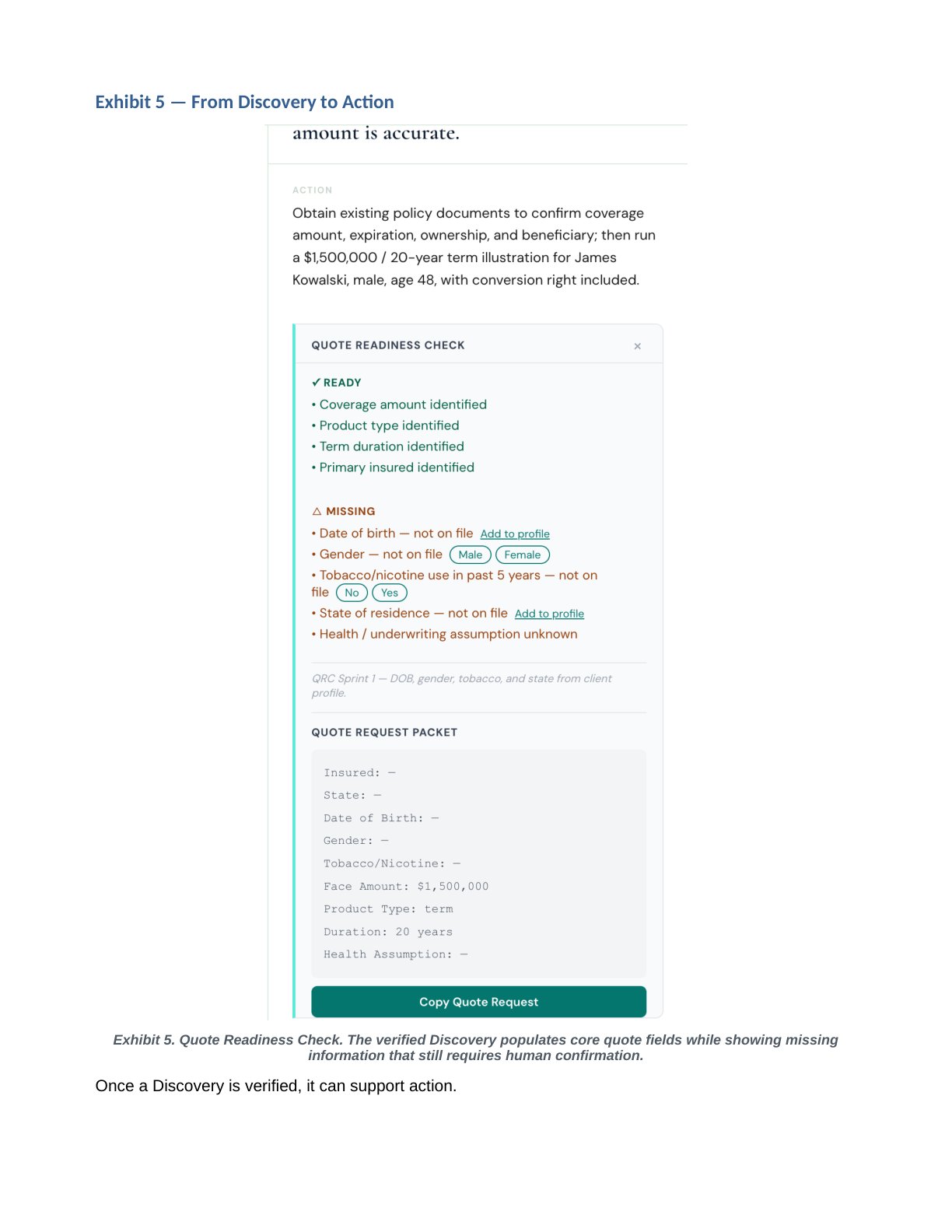
From Discovery to Action
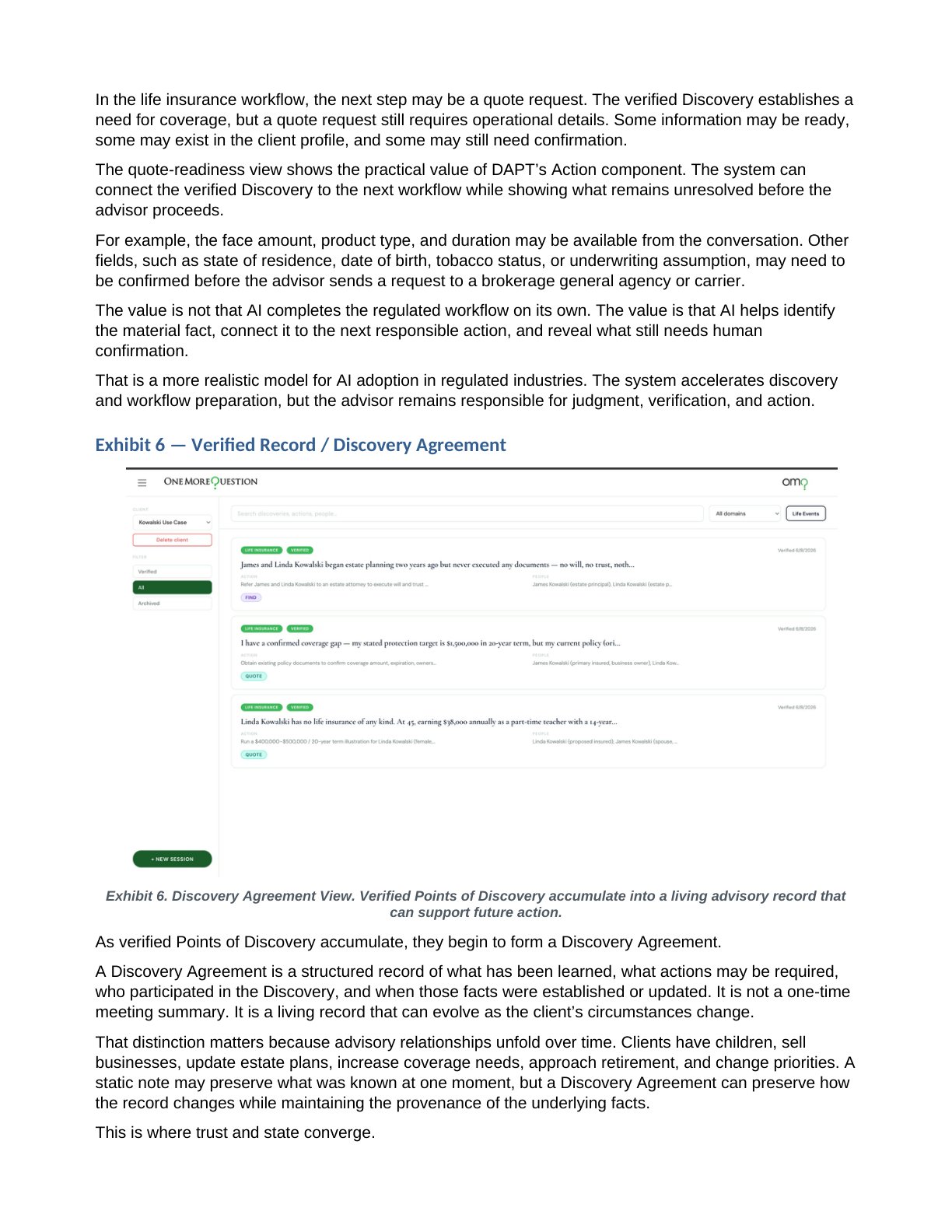
Verified Record and Discovery Agreement
[Video Title]
Video walkthrough of The Trust Gap. Available at launch.
The Kowalski Example — Video
A companion video to Section 10. Walks through the Kowalski case study exhibit by exhibit — showing exactly where the trust architecture held, where it failed, and what a trust-architected approach would have looked like.
Case study walkthrough — Section 10, the Kowalski Example. Available at launch.
Read the full paper.
The Trust Gap is available as a full PDF.
Trust Architecture
A structured operating framework for advisors, carriers, and distribution teams navigating AI adoption in regulated financial services and insurance environments.
Trust Architecture gives organizations a way to govern the lifecycle of material advisory facts — what was discovered, what action may follow, who participated in the Discovery, and when the information was established or updated.
The Trust Architecture Framework
The structural foundation.
The Trust Architecture Framework is a framework for designing AI-enabled advisory workflows that preserve accountability, provenance, privacy, human oversight, and auditability. It defines the conditions under which AI-generated information can be responsibly relied upon inside regulated workflows.
Trust Architecture addresses the full lifecycle: how information is discovered through human inquiry, how AI processing changes that information's state and purpose, and how the resulting outputs can be governed, reviewed, and acted upon by regulated practitioners.
Additional detail in The Trust Gap white paper.
DAPT
Discovery, Action, People, Timestamp.
DAPT is a compact schema for governing the lifecycle of a material advisory fact. It records the four dimensions that determine whether an AI-generated or AI-assisted discovery can be responsibly relied upon inside a regulated workflow.
Discovery
The fact as discovered through human inquiry — the source material before AI processing. The Discovery dimension records what was learned and preserves its original form.
Action
What action may follow from this discovery — the downstream use of the fact in a regulated decision, recommendation, or workflow. Action defines the scope and limits of reliance.
People
Who participated in the Discovery — the advisor, the client, any AI system involved, and the human reviewer responsible for Clarify/Verify. People establishes accountability and provenance.
Timestamp
When the fact was established, when it was last updated or verified, and when reliance on it expires. Timestamp is the governance anchor for recordkeeping and auditability.
Clarify/Verify
Human review before reliance.
Clarify/Verify is the human review process that allows AI-generated discoveries to be challenged, corrected, updated, and verified before reliance. It is the mechanism that keeps AI output from being passively accepted into governed workflows without practitioner review.
Clarify
The practitioner reviews the AI-generated discovery against their own knowledge of the client, the conversation, and the context. Discrepancies, gaps, or errors are identified and flagged for correction — not suppressed or overridden silently.
Verify
The corrected or confirmed discovery is verified and committed — moving from AI Processing State to Human Working State. The Verify step creates the governance artifact: a reviewed, accountable fact that can be relied upon in regulated decisions.
Clarify/Verify applies at the individual advisor level, the enterprise compliance function, and in any automated workflow where AI output requires human review before downstream action.
Trust Boundaries
Where information changes state.
Trust Boundaries identifies the points where information changes state, purpose, system, or control environment. These transitions are the highest-risk moments in any AI-assisted advisory workflow — moments where provenance, accountability, and human oversight must be deliberately designed, not assumed.
Key state transitions include:
Source State
Information as first discovered through human inquiry — in its original, unprocessed form. The foundation of the Discovery Agreement.
AI Processing State
Information as transformed, synthesized, or augmented by AI — requiring Clarify/Verify before it can be relied upon in governed action.
Human Working State
Information that has been reviewed, verified, and accepted by a human practitioner for use in regulated decisions and recordkeeping.
Discovery Agreement
A living record of verified discovery.
The Discovery Agreement is a living record of what has been learned through advisor-led inquiry, who participated in that Discovery, what action may follow from the discovered facts, and when each fact was established or last updated.
The Discovery Agreement is not a static document signed at onboarding. It is the ongoing governance record of the client relationship — updated as new discoveries are made, as facts are clarified or revised, and as the scope of reliance expands or changes over time.
In the OMQ platform, the Discovery Agreement is the central artifact around which every session is organized. It is the record that compliance can review, the advisor can reference, and the client can verify.
AI that cannot be reviewed cannot be trusted.
Information that cannot be governed cannot be relied upon.
The financial services and insurance industries have invested in compliance infrastructure, disclosure requirements, and suitability standards. What they have not invested in is the architecture of trust itself — or the governance frameworks that make AI adoption responsible.
Trust Architecture addresses both.
Read the Research Behind the Framework
Advisory
We advise insurance and financial-services organizations on trust-centered AI adoption, advisor workflows, distribution strategy, and implementation readiness.
Continuity Ventures works directly with carriers, BGAs, RIAs, broker-dealers, compliance leaders, and strategic partners on paid advisory engagements. Research establishes the thesis. Advisory is where that thesis becomes practice.
AI adoption in regulated environments is not a technology problem. It is a trust problem.
The challenge is not whether AI can produce useful outputs. The challenge is whether those outputs can be trusted inside governed workflows — by clients, by compliance, and by the practitioners responsible for them.
Continuity Ventures advises organizations on how to move from human inquiry to AI-enabled workflows without losing the client trust, regulatory standing, or institutional credibility that makes those relationships valuable in the first place.
We help regulated organizations design AI workflows that preserve trust as information moves from conversation to action.
How we work together.
AI Workflow Readiness
Helping firms assess where AI can safely enter advisor, distribution, underwriting, service, or compliance workflows. Identifying trust boundaries, governance gaps, and implementation sequencing before deployment begins.
Trust Architecture Design
Mapping consent, de-identification, human review, auditability, retention, and use-case boundaries across AI-assisted workflows. Producing governance artifacts that compliance and regulators can review.
Distribution Strategy
Helping carriers and distribution organizations think upstream — where client information is first discovered, how it flows through AI-assisted systems, and where trust is made or lost before a product is ever offered.
OMQ Workflow Demonstrations
Using OMQ as a live proof environment for Trust Architecture in practice. Demonstrating what AI-assisted discovery looks like when it is governed, consent-based, and audit-ready — not just technically functional.
Executive Briefings & Workshops
Workshops for leaders, compliance teams, advisors, and distribution organizations on regulated AI adoption, Trust Architecture, and DAPT-based workflows. Available as half-day, full-day, or multi-session engagements.
Training & Certification
Workshops and briefings for organizations exploring AI-enabled advisory workflows. Training curriculum in development — available on request.
How engagements begin.
Most advisory relationships begin with a conversation. We do not have a standard intake form or a fixed pricing page — because the work is different for every organization.
Tell us where you are. We will tell you whether we can help.
Carrier or Enterprise Engagement
Multi-session advisory work, Trust Architecture design, or embedded workflow readiness assessment.
Advisor or RIA Engagement
Practice-level Trust Architecture, Discovery Agreement implementation, or OMQ onboarding.
Speaking & Briefings
Executive presentations, compliance briefings, and conference keynotes on regulated AI adoption and Trust Architecture.
Strategic Partnership
Carrier, BGA, or technology partners exploring Trust Architecture as an embedded capability or distribution asset.
OMQ
The first working implementation of the Trust Architecture thesis â demonstrating how advisor-client conversations become structured Points of Discovery, governed by Clarify/Verify, and connected to responsible next actions.
OMQ is not the whole company. It is proof that trust-centered, governed AI adoption works in practice — inside the advisor-client discovery conversation where client information is first created.
Every client relationship begins with a question.
OMQ makes that conversation governable.
OMQ is not the whole company. It is the first working implementation of the Trust Architecture thesis.
OMQ is the first working implementation of Continuity Venturesâ Trust Architecture thesis. It is currently being used in real advisory work to test and demonstrate how fact-finding conversations can become structured Points of Discovery, reviewed through Clarify/Verify, and connected to responsible next actions.
The platform operationalizes the Discovery Agreement — the consent and governance document that defines what AI can and cannot do inside a client relationship — and creates a structured, reviewable record of every discovery session.
How OMQ works.
Begin New Discovery
Conduct a structured, AI-assisted discovery session by voice or text. The session is governed by the Trust Architecture framework and documented from the first question.
Submit Past Discovery
Paste or upload an existing discovery transcript for AI-assisted analysis, structuring, and governance review — bringing historical conversations into the Trust Architecture framework.
Pod Library
Access verified discoveries — structured, reviewed, and compliant client fact sets that meet the governance standards required for AI-assisted advisory workflows.
OMQ is what Trust Architecture looks like when it runs.
Every session in OMQ is governed by the five components of the Trust Architecture framework — from the Discovery Agreement that opens the conversation to the Clarify/Verify protocol that closes it.
OMQ is proof that regulated AI adoption does not require sacrificing the client relationship to achieve it.
Explore Trust Architecture →
Request access to OMQ.
OMQ is currently available to qualified partners. Advisors, carriers, and distribution organizations interested in access can initiate a conversation below.
Start a ConversationInsights
Research notes, practitioner analysis, and applied perspectives on trust and regulated AI adoption in financial services and insurance.
AI Adoption Is Blocked by Trust, Not Capability
Models are improving quickly. Regulated adoption depends on whether the workflow can be governed, reviewed, and responsibly relied upon.
Read →
The Unit That Matters Is the Fact
In advisory workflows, the most important unit is often not the document, record, or model. It is the material fact discovered through conversation.
Read →
Why Carriers Should Start at the Distribution Edge
The information powering underwriting, service, suitability, planning, and future enterprise workflows is first discovered in distribution.
Read →
The Five Signals of Trust Drift in Client Relationships
Before a client exits, they signal. Most advisors and carriers miss every one.
Client attrition in financial services and insurance is rarely sudden. It is the end of a process — a gradual withdrawal of confidence that begins long before the client makes the decision to leave.
In the research underlying The Trust Gap, we identified five recurring signals that appear in client relationships before exit. They appear across advisory and insurance contexts. They appear in both high-net-worth and mass-affluent relationships. And they are almost always present, in retrospect, even when the practitioner did not see them at the time.
1. The client stops asking questions.
When trust is intact, clients ask questions — about strategy, about markets, about alternatives. When a client stops asking, it does not mean they have become satisfied. It means they have concluded that the questions are not worth asking. They are managing the relationship, not engaged in it.
What to do: A structured Clarify session — not a check-in call — that invites the client to surface concerns explicitly. "What would you want to revisit if we had a full hour?" does not invite a yes.
2. The client introduces a third party.
A spouse who wasn’t previously involved. A CPA who wants to be copied. An adult child who starts attending meetings. Third-party introduction is frequently a trust signal — the client is importing a validator.
What to do: Welcome the third party as a new principal, not a guest. Address their trust formation needs directly.
3. Response time slows.
The client takes longer to return calls, respond to emails, or schedule reviews. In most cases it is distance — the client is deprioritizing the relationship because they are less invested in it.
What to do: Do not increase contact frequency. Increase contact quality. One meaningful communication is worth more than three generic check-ins.
4. The client narrows the scope of the relationship.
They stop asking about the full picture and begin asking only about a subset. They are rationalizing the relationship down to its minimum viable form, in preparation for a transition that may or may not come.
What to do: Re-surface the full scope explicitly, in the context of the client’s current situation.
5. The client begins comparing.
References to other advisors, other products, or industry averages appear in conversation. These are almost always evaluation.
What to do: Engage the comparison directly. "It sounds like you’ve been doing some research — I’d like to understand what you’ve been looking at." Avoiding the conversation accelerates the process.
The full analytical framework is available in The Trust Gap.
Download The Trust Gap
Built by practitioners,
for practitioners.
Continuity Ventures is a research and advisory platform focused on distribution-first AI strategy for insurance and financial services. Full profile coming soon.
Rusty Iodice
Founder, Continuity Ventures
Founder profile coming soon.
We built the research before we built the firm.
Coming soon.
A research and advisory platform.
Research establishes the thesis. Advisory puts it into practice. Implementations prove it works.
The Trust Gap
White paper on trust failure and AI adoption in financial services and insurance.
Trust Architecture
The operating framework for trust-centered, governed AI adoption in regulated environments.
Consulting & Engagements
Paid advisory work with carriers, advisors, compliance leaders, and strategic partners.
OMQ · CDS · Training
Working implementations of the Trust Architecture thesis. In active development.
Ready for a serious conversation?
We work with carriers, advisors, compliance leaders, and distribution organizations.
Get in touch.
We work with practitioners and organizations who take regulated AI adoption seriously. Tell us where you’re coming from.
You advise clients directly.
Whether you’re looking to apply the Trust Architecture framework, explore a Discovery Agreement template, or understand how OMQ fits your practice — we want to hear from you.
You operate at scale.
Carriers, MGAs, and enterprise distribution teams working on AI workflow readiness, producer trust infrastructure, or distribution relationship quality.
You manage risk.
The Trust Architecture framework has compliance and fiduciary implications for AI-assisted advisory workflows. We’re available to discuss from a regulatory or risk management perspective.
You’re evaluating at the organizational level.
If you’re assessing Continuity Ventures, Trust Architecture, or OMQ as an organizational partnership, embedded solution, or strategic investment — we’ll match the seriousness of your evaluation.
You want to put this in front of an audience.
Rusty Iodice speaks on regulated AI adoption, Trust Architecture, and distribution-first AI strategy in financial services and insurance.
Prefer to reach out directly?
We respond to all inquiries within two business days.
Privacy Notice
Continuity Ventures · continuityventures.com
Effective Date: June 2026 · Last Updated: June 2026
1. Overview
Continuity Ventures operates continuityventures.com. This Privacy Notice describes how we collect, use, and handle information when you visit the Site or interact with us. We do not sell personal information. We do not operate an advertising platform.
2. Information We Collect
Information you provide: Name, email, firm name, job title, and message content when you contact us or download materials. Automatically collected: Standard analytics data through privacy-respecting analytics. Cookies: essential cookies only.
3. How We Use Information
To respond to inquiries, send requested materials, notify you of relevant updates where you have opted in, and improve the Site. We do not use your information for advertising or share it with third parties except as required by law.
4. Communications
You can opt out of any communications at any time by replying "Unsubscribe" or contacting us directly.
5. Data Retention
We retain contact information for as long as necessary to fulfill the purpose for which it was provided, or as required by law.
6. Your Rights
Depending on your location, you may have rights to access, correct, or request deletion of your information. Contact us at rusty@completeconnect.net.
7. Third-Party Links
The Site may link to third-party websites. We are not responsible for their privacy practices.
8. Changes
Material changes will be noted by updating the "Last Updated" date above.
9. Contact
rusty@completeconnect.net
Continuity Ventures · Available upon request.